The exercise your program keeps skipping
Look back over a month of training. There are squats in there, probably deadlifts, leg press if you have one. Now look for anything you did on one leg at a time. For a lot of lifters the honest answer is nothing, for months.
It is not a decision anyone makes. Split squats are awkward, they use embarrassing weights compared to the barbell, and they are the easiest thing to drop when a session is running long. So they get dropped, every week, until they are simply not part of training any more.
What gets lost
Squatting with two legs lets the stronger side carry more of the work, and nothing in the session tells you it is happening. Standing, walking and climbing stairs all happen one leg at a time, so a difference between sides shows up in life long before it shows up in the gym.
The case for keeping it in is about staying strong and steady on one leg as the years go by. Yield does not claim it prevents falls or injuries, because that is a bigger claim than the evidence supports for any single exercise.
How Yield keeps it in the week
Yield keeps track of the single-leg work you have actually trained this week, such as a split squat, lunge, step-up or single-leg Romanian deadlift, against a weekly target that fits how often you train.
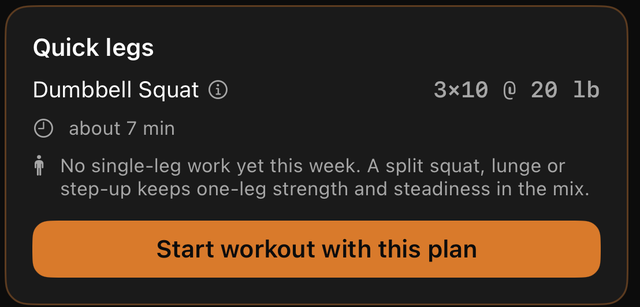
If you are short, your coach makes room for one alongside the two-legged work. The plan card tells you why before you accept it, with a line like "No single-leg work yet this week", so the reason is visible rather than buried in the exercise list.
Once the target is met for the week, the coach leaves it alone. Nothing nags you about a target you have already hit.
If you do not want it
There is a switch in Profile. Turn off weekly single-leg work and the coach stops making room for it and stops bringing it up. It is your training.
The catalog carries the movements either way. It marks the exercises that train one leg at a time, so searching "single leg" finds them whether or not the weekly target is on.
Knowing whether it is working
Strength on one leg is hard to see in a training log, because the weights are small and progress is slow. The balance check is the other half of the picture: a two-minute measurement of how steady you are on each leg, taken every couple of weeks, so a difference between sides is a number rather than a feeling.
More on that in how long can you stand on one leg, and on how a session gets built in setting a weekly split and seeing what is up next.
Yield Strength is in beta on TestFlight. Read more about what makes it different, or join the waitlist to try it yourself.