How long can you stand on one leg?
Stand up and lift one foot off the floor. Most people are surprised twice. First by how quickly the ankle starts working, and then by the gap between the two sides. One leg feels solid. The other feels like standing on a boat.
That gap is easy to notice once and then never think about again. There is no number attached to it, so there is nothing to compare next month. Yield gives it a number.
Why one leg at a time is worth measuring
A study by Araujo and colleagues, published in the British Journal of Sports Medicine in 2022, followed middle-aged and older adults who were asked to stand on one leg for ten seconds. Those who could not complete it had roughly double the risk of death over the following seven years, after the researchers accounted for age, sex, body size and several clinical measures (Araujo et al., 2022).
That is an association, not a promise. Standing on one leg for longer does not extend anyone's life on its own, and no single test predicts what happens to any one person. What it does say is that balance carries real information about how a body is doing, and that it is cheap to check.
What the check actually does
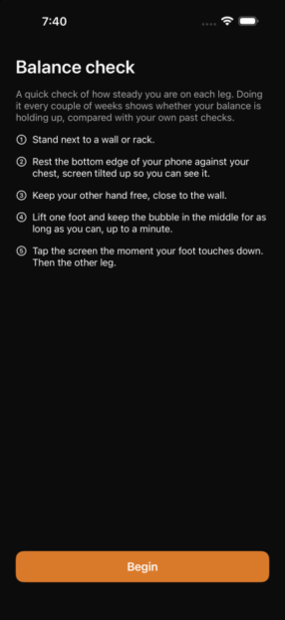
Yield offers a balance check every couple of weeks from the Train screen, and you can start one any time from Profile. It takes about two minutes.
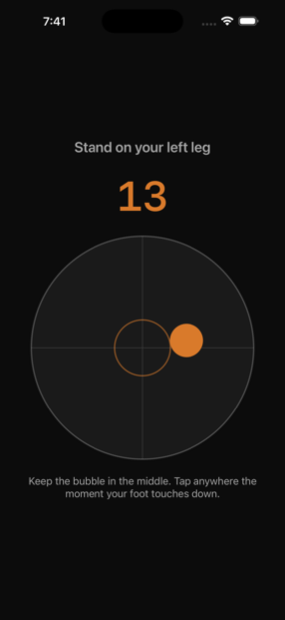
You hold the bottom edge of the phone against your chest with the screen tilted up so you can still see it. A bubble sits in the middle of the screen like a spirit level and moves with you, so the phone is showing you what it is measuring while it measures. There is a three-second count to get set, then you lift one foot. When you put it down, you tap. The other leg follows.
Nothing decides for you that you have finished. The tap is yours. A minute is the maximum, which is long enough that most people put a foot down first.
What the number means
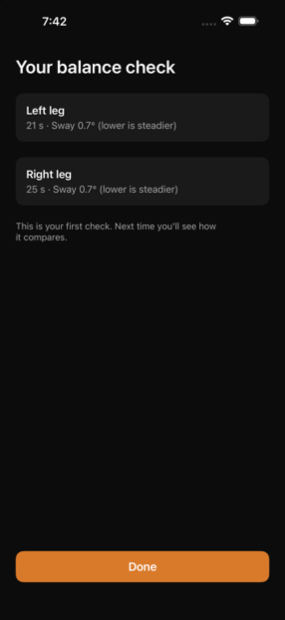
Two things come back for each leg. How long you held it, and a sway figure in degrees, which is how much the phone tilted while you were up there. Lower is steadier.
The number is only meaningful against your own earlier checks. It is not a score, there is no national average in the app, and no reading here says anything about anyone's health. What it is good for is the comparison: this leg against the other, and this month against three months ago.
What happens with the result
Results appear in Progress, with the change since last time in plain words, such as six seconds longer and twenty-five per cent steadier. Your coach can see them too. If one leg is clearly weaker, that is a reasonable argument for a little extra work on that side, and the coach will say so when you ask.
The checks follow you. They are stored on your phone and on the server, so a new phone does not lose the history, which is the whole point of a measurement you take every few weeks.
Related: the exercise your program keeps skipping, and how Yield tracks what you have recovered from.
Yield Strength is in beta on TestFlight. Read more about what makes it different, or join the waitlist to try it yourself.